There is a malicious role behind the attack on Israel.
Hamas’s leader Chana is a radical,
The military commander Deif is even more ruthless.
On the morning of October 7, local time, the Israelis were celebrating the Sabbath and the festival of Sihtola when the alarm suddenly came.
Palestinian Islamic Resistance Movement (Hamas) launched a rocket attack from the Gaza Strip, allegedly launching about 5,000 rockets. Dozens of Israeli armed men sneaked into Hamas and launched an attack.
Hamas’s action, code-named "Al-Aqsa Flood", drew a tough response from its opponents. The Israeli army launched the operation code-named "Iron Sword" to attack Hamas targets in the Gaza.
According to the statistics of the Israeli medical department on the morning of October 8th, the new round of conflict between Palestine and Israel has killed more than 300 Israelis, injured more than 1,800, and taken dozens of Israelis into Gaza. On the same day, the health department in the Palestinian Gaza said in a statement that 313 people were killed and 1,990 injured in the Israeli attack on the Gaza.
Israeli Prime Minister Benjamin Netanyahu said: "We are at war."

Leaders from refugee camps
According to the Jewish Chronicle, on October 7th, Hamas released a photo of "Israeli Major General Captured". In the picture, Israeli general nimrod Aloni was taken away in the street wearing a T-shirt and underwear.
On the same day, Hamas leader ismail haniya said in a televised speech that Hamas was on the verge of victory. He said that Palestinians have been waging "uprisings and revolutions" to liberate Palestinian land and Israeli detainees. This cycle "must end".
"Hamas is a radical Palestinian rebel against Israel." Zhu Zhaoyi, director of the Israeli Center in university of international business and economics, told the global person reporter that "the leader of the organization, Chana, is also a radical."
Chana was born in Ashkelon village in Gaza in 1963 and grew up in a refugee camp. Because of the war and poverty, he didn’t even know his date of birth.
As a teenager, Chana attended a refugee school established by the United Nations in Gaza. In 1981, Chana entered Gaza Islamic University to study Arabic literature. At school, he was a student activist and later joined the Muslim Brotherhood.
In 1987, the "Palestinian Uprising" broke out. Palestinians in the Gaza took to the streets to protest against the Israeli occupation by means of demonstrations and strikes. Chana, 24, took part in the protest. After the uprising, he was arrested by Israel and imprisoned for six months.
It was in this uprising that Hamas was born. Young Chana became one of the founders of Hamas. Hamas is recognized as an illegal organization by the Israelis. Two years later, Chana was arrested again by the Israeli authorities. After three years in prison, he was released in 1992 and deported to southern Lebanon.
In 1993, Palestinian President Arafat and then Israeli Prime Minister Rabin signed the Oslo Accords, which eased Palestinian-Israeli relations. Chana was able to return to Gaza. This time, Chana’s prestige has greatly increased. He was appointed as the president of Islamic University, and was highly valued by Yassin, the leader of Hamas at that time. In 1997, he became Yassin’s private secretary, thus entering the leadership of Hamas.
Since then, Chana has been the target of assassination by the Israeli army. According to reports, the Israeli army assassinated Yassin and Chana many times in 2003, and they escaped, but Yassin was finally stabbed to death. Chana took over and became the actual leader of Hamas.
In the following years, Hamas moved in Gaza, and its scale expanded further.
In 2006, the first Legislative Council election was held in Palestine, and Hamas defeated the Palestinian National Liberation Movement (Fatah) and won a majority of seats. Later, Chana became prime minister, ranking second only to President and Fatah leader Abbas.
However, there are internal contradictions between Hamas and Fatah. By 2007, the two sides split and Chana was dismissed by Abbas. Hamas occupied the Gaza on the east bank of the Jordan River, while Fatah controlled the West Bank. In the conflict with Fatah, Hamas militants occupied Abbas’s office in just five days.
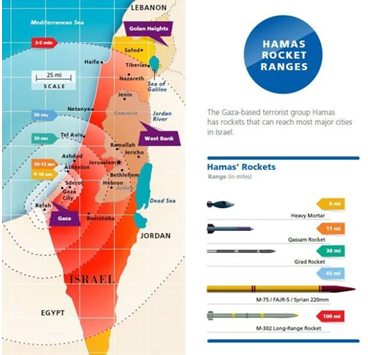
·Hamas possesses weapons of various ranges.
In recent years, Hamas has been constantly recruiting, and its strength has been improved. It is said that Hamas now possesses weapons with various ranges, and its attack range can cover almost all of Israel.

"escaped at least five assassinations."
Muhammad Deif, the military commander of Hamas, is a "tough guy". For many years, he was regarded as the most mysterious leader in Hamas.
·The report about Deif in Israel Times.
According to the Israel Times, Deif issued a statement on October 7. He said that the action was in retaliation for Israel’s "desecration" of the Al-Aqsa Mosque on the Temple Mount in Jerusalem, and also in response to the killing and wounding of hundreds of Palestinians by Israel this year.
Deif called on Lebanese, Iraqi, Syrian and other countries’ Islamic Resistance Movement and Palestinian resistance to unite and "start marching into Palestine now". He said, "We warned the enemy" and "We can’t stand it".
Deif also shouted in the video: "Today, everyone with a rifle should take it out, and everyone should come out with a truck, a car or an axe!" The Israel Times said that this video was widely forwarded on social media. This is also the first appearance of Deif in 2021.
Despite being the commander in this raid, Deif has been hidden behind the scenes for a long time. Apart from members of Hamas, little is known about him. An important reason why he remains mysterious is that he has been Israel’s "most wanted man" since 1995.
In 1965, Deif was born in a refugee camp in Gaza. In 1990, at the age of 25, he joined Hamas after a miserable adolescence.
Two years ago, the Israel Times reported him like this: "Last week, the IDF tried to’ clear’ him twice, but both failed." The newspaper said that in the past 20 years, the Israeli army tried to assassinate him at least five times. "In the assassination plan in 2003, Deif was blind in one eye. In 2006, he was seriously injured and lost his legs and an arm. " Later, when the BBC reported on Deif, he called him "one-eyed".
In 2014, the Israeli army once again implemented a clearance plan for Deif. At that time, the Israeli Air Force Command discovered the suspected hiding place of Deif. On August 19th, two Israeli fighter planes flew to a small apartment in Gaza’s Xie Chlad Wan area and dropped bombs. Soon the news of Deif’s assassination came out. But not long after, Deif was confirmed to be alive. However, his wife, 3-year-old daughter and several-month-old son were all killed in the air raid.
According to reports, Israel’s latest attempt to assassinate Deif was in the "Guardian of the Great Wall" operation in May 2021.

Seek the way to lasting peace
Zhu Zhaoyi said: "This is the most serious conflict between Palestine and Israel since 2006, and its scale is almost equivalent to a war. Seventeen years later, Israel once again entered the wartime state of national mobilization. "
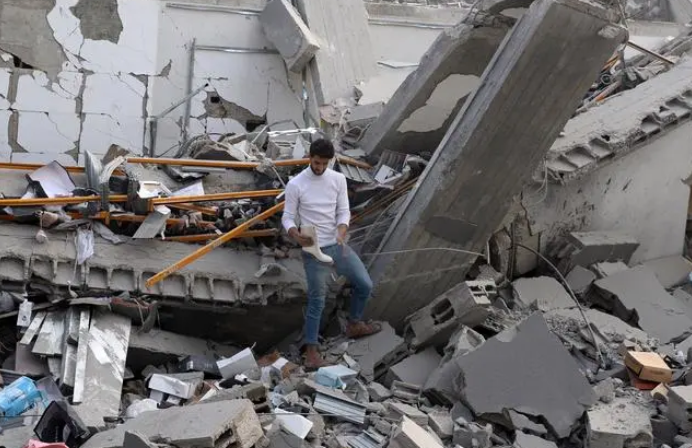
·On October 8, Palestinians in the Gaza looked at the ruins of buildings after Israeli air strikes. (Xinhua News Agency)
The Palestinian-Israeli conflict has a long history. "According to UN Resolution 181 of 1947, Israel and Palestine were founded in this territory in 1948. Israel quickly agreed to establish a country, but Palestine and neighboring Arab countries did not agree. " Zhu Zhaoyi said. For the sake of Palestinian statehood, four Middle East wars broke out between Arab countries and Israel, and Israel occupied part of the territory allocated to Palestine by United Nations resolutions. "The Middle East has become a pawn in the game of big countries."
However, specific to this conflict, the situation is not simple. "Accurately speaking, this round of conflict is actually not a’ Palestinian-Israeli conflict’, but a’ Kazakhstan-Israel conflict’." Zhu Zhaoyi said.
Fatah has always been the largest faction in the Palestine Liberation Organization and controls the Palestinian National Authority. Compared with Hamas, Fatah is a "moderate" and has held several rounds of negotiations with the Israeli authorities. However, the two sides have never been able to talk about the demarcation of the Palestinian-Israeli border, Jewish settlements and the return of Palestinian refugees, and bloodshed has occurred from time to time.
Hamas, on the other hand, advocates using force to resist the Israelis. Chana said to other Arab countries: "Our Arab brothers, the normalization agreement you signed with Israel over the past years can’t solve the Palestinian-Israeli conflict. You see, the Israelis can’t even protect themselves, how can they provide you with protection?"
"This round of conflict in Hamas should have been brewing for a long time." Zhu Zhaoyi said, "For Israel, this is a major intelligence error. After the end of this conflict, the Israeli military, political and intelligence departments will carry out a major exchange of blood. "
After the conflict broke out, Palestinian President Abbas said on October 7 that the Palestinian people have the right to defend themselves and oppose "the terrorist acts of settlers and occupation forces".
The sudden escalation of the Palestinian-Israeli situation shocked the world, and the international community quickly responded to it.
According to Iran’s state news agency, the advisor of Iran’s supreme leader Khamenei expressed support for Hamas’s attack on Israel.
The United States, the European Union and others condemned Hamas’s "terrorist attack" on Israel in unison, and expressed their solidarity with Israel.
More countries want the conflict to cool down. The Egyptian Foreign Ministry said that as a mediator between the two sides, Egypt has been trying to find a way to stop the bloody conflict. Egyptian Foreign Minister Chucri said that he is in close communication with his counterparts in other countries to prevent the situation from escalating.
Turkish President Erdogan delivered a speech on October 7, calling on all parties to exercise restraint and not to take impulsive actions that lead to escalating tensions.
Saudi Arabia said that it is paying close attention to this "unprecedented" situation and called on both sides to stop their actions immediately.
Russian Foreign Ministry officials said that they were in contact with Israeli and Palestinian officials and called for an immediate ceasefire.
With regard to the escalation of the Palestinian-Israeli conflict, a spokesman for China’s Foreign Ministry said: China is deeply concerned about the current escalation of tension and violence between Palestine and Israel, and calls on all parties concerned to maintain calm and restraint, immediately cease fire, protect civilians and prevent the situation from deteriorating further. Repeated Palestinian-Israeli conflicts fully demonstrate that the long-term stagnation of the peace process is unsustainable. The fundamental way to calm the Palestinian-Israeli conflict lies in implementing the "two-state plan" and establishing an independent Palestinian state. The international community should enhance its sense of urgency, increase its investment in the Palestinian issue, promote the early resumption of peace talks between Palestine and Israel, and seek a lasting peace. China will continue to make unremitting efforts with the international community to this end.
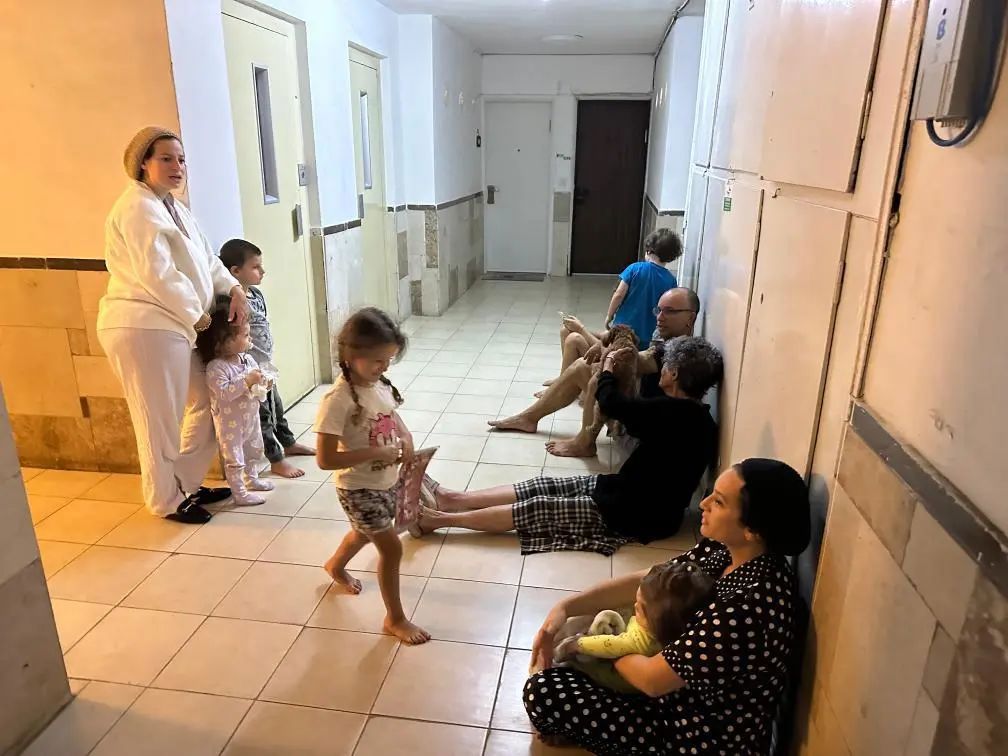
·On October 7, after the air defense alarm sounded, people took refuge in a building in Jerusalem. (Xinhua News Agency)