China Daily Online, July 4 th On June 30 th, the National Development and Reform Commission and the Ministry of Commerce issued the National Edition and Free Trade Zone Edition "Special Management Measures for Foreign Investment Access (Negative List)" and "Catalogue of Industries Encouraging Foreign Investment", which means that China encourages foreign investment to gradually normalize and step into the stage of stabilizing foreign investment by improving business environment and rules. China’s heavy-handed measures to further open up foreign investment have injected a booster for foreign companies to increase their investment in China.
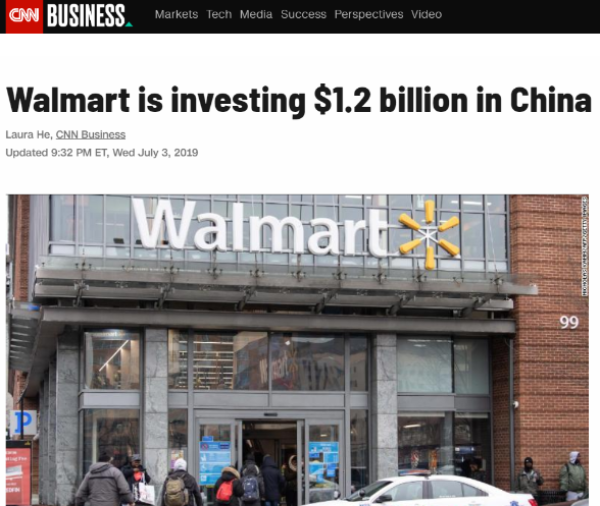
According to a report by CNN)7 on July 3, American retail giant Wal-Mart said on Monday that it plans to invest 8 billion yuan in China in the next 10 years to upgrade its logistics system, and the company will build or upgrade more than 10 logistics centers in China.
"Wal-Mart will continue to increase its investment in supply chain logistics … … Provide China consumers with the freshest goods and the most convenient services. " Ryan McDaniel, senior vice president of Wal-Mart’s supply chain in China, said.
Mai Ruien said that it was because we saw the future potential of China retail market that we decided to invest. The publication of the Catalogue of Industries Encouraging Foreign Investment further supported our strategy of investing in upgrading the logistics distribution center in China market. In the future, Wal-Mart will continue to strengthen its long-term investment in the logistics supply chain in China market to drive omni-channel business development and continuously improve the supply chain capabilities. In the next 10 years, Wal-Mart will invest 8 billion yuan to build or upgrade more than 10 logistics distribution centers in China market.
Previously, Wal-Mart has invested 700 million yuan to set up the Wal-Mart South China Fresh Food Distribution Center to cater to the needs of more and more online shopping consumers.
This Arkansas-based multinational company entered China in 1996. At present, there are more than 400 stores and 18 logistics distribution centers in China market, with dozens of new stores opening every year. Last year, the sales in China market reached 10.7 billion US dollars.
At the end of 2016, Wal-Mart once again increased its shareholding in JD.COM to 12.1%, becoming the third largest shareholder of the China e-commerce giant. Since then, Wal-Mart has expanded its e-commerce business in China and started testing "smart supermarkets".
"I think China will be a huge business opportunity," Doug McMillon, CEO of Wal-Mart, said at an investor conference in June.
In fact, according to UNCTAD data, global foreign direct investment dropped by 13% year-on-year, while the China market attracted 4% foreign investment year-on-year. According to the Ministry of Commerce of China, in the first five months of this year, China’s foreign investment continued to rise against the trend, and the actually used foreign investment reached 369.06 billion yuan, up 6.8% year-on-year, and the growth rate was more than five times that of the same period last year, showing the strong attraction of the China market.
According to the CNBC website of the United States reported on July 2nd, the German software giant SAP believes that the China market has a "huge" opportunity and will seek to expand in China. Headquartered in waldorf, SAP occupies an important position in the enterprise resource management (ERP) software market and is one of the largest enterprise application software providers in the world.
Last September, the company and China e-commerce giant Alibaba announced that they would jointly provide cloud service solutions for enterprises.
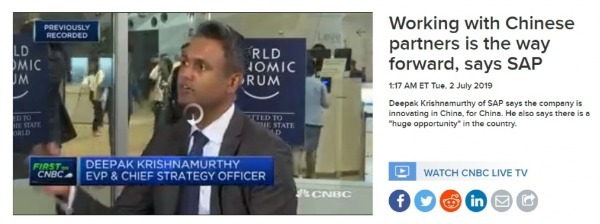
At the Summer Davos Forum held in Dalian, China, Deepak Krishnamurthy, executive vice president of SAP, said: "We believe in this cooperation model."
He said that SAP has more than 3,000 developers in China, and we are also innovating together with China.
Deepak said that as the second largest economy in the world, "China has great opportunities".
Just in January this year, SAP released the "China Acceleration Plan", saying that it will continue to increase its investment in the China market in the next five years, including building a new ecosystem, deepening the SME market, increasing investment in talents and facilities, opening three new offices in China, and establishing branches in 10 cities within two years.