Text/zero degree
Product/node finance
The annual 3.15 party is about to begin. From 1983, it came out as "International Consumer Rights Day", and March 15th is nearly forty years old.
Earlier, former US President John F. Kennedy put forward four rights of consumers in the "Special Presidential Address on Protecting Consumers’ Interests": the right to security; Have the right to obtain correct information; Have the right to choose freely; Have the right to put forward consumer opinions. In the following years, these four articles have become the consensus of the international community.
So how is the protection of consumer rights? From the exposure of the annual 3.15 party, infringement also presents certain characteristics: traditional infringement is being paid attention to, but emerging infringement methods are emerging one after another, and the infringement industry is also expanding. But to be fair, this is not to say that the tort capacity has also "progressed" with GDP. It is very likely that, first, with the progress of society, consumers pay more and more attention to self-protection and their legal awareness is awakening; Secondly, there are more and more actions of trade associations.
The industry I want to talk to everyone today is cosmetics. Although cosmetics do not seem to be the "darling" of the 3.15 parties over the years, it does not mean that beauty cosmetics are absent from 3.15. In fact, influenced by the "face value economy", "consumption upgrade" and the awakening of self-awareness, cosmetics have gradually changed from optional consumption to compulsory consumption, the market scale has been expanded again and again, and infringement acts are also varied, not only in the well-known high-incidence areas of quality problems, but also in a laundry list of other hidden infringements. Today, I will take you to take stock.
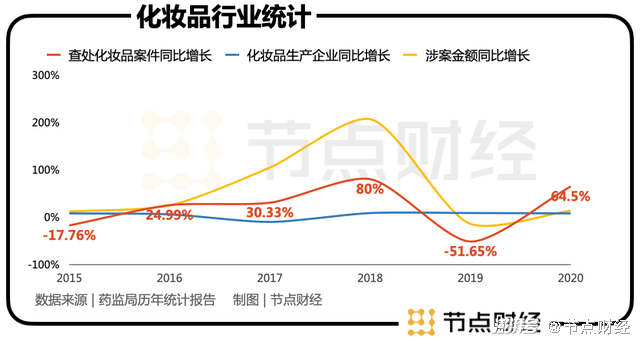
We made a statistic. In recent years, the number of cosmetics manufacturers has grown steadily, from 4,216 in 2014 to 5,657 in the first half of 2021, and the annual growth rate of enterprises is basically within 10%. The steepness of the year-on-year growth curve of the amount involved and the investigation of cosmetics cases is far better than that of cosmetics production enterprises. Infringement, or the degree of infringement discovered, is deeper. By 2020, supervisory organizations at all levels will investigate and deal with 14,316 cosmetic cases, involving 204 million yuan.
A good phenomenon is that after 2018, the growth rate of the two curves decreased significantly, and it was negative in 2019, but there are signs of recovery in the near future. For example, in the first half of 2021, the number of cosmetic cases investigated by supervisory agencies at all levels reached 9,779.
So what are the "ghosts and monsters" in the cosmetics industry? Let’s look at the four rights.
/ 01 /
"Have the right to security"
There are many kinds of composition problems, and the moon in any country is not so round.
One of the unavoidable effects of cosmetics is whitening, and hormones and lead and mercury have immediate "skin rejuvenation and whitening" effects. But its long-term use is very harmful. The ingredients with low cost and high immediate effect have become the choice of many businesses.
In the general cognition of consumers, domestic skin care products are relatively low in price, poor in quality and function, especially the products produced by some small workshops, which tarnish the image of domestic cosmetics. Of course, this is not without reason. For example, some famous brands, such as Nature Hall and herborist, which are common in public view, have been pointed out to contain hormones.
Do you think this is just a relatively cheap unique behavior of domestic skin care products? No, as early as 3.15 years ago, there were many international first-line brands on the list of unqualified cosmetics, such as SKII, L ‘Oreal and Mary Kay containing hormones. The contents of lead and mercury in Shiseido’s skin lotion, Clinique’s firming essence and Nivea’s beauty-repairing day cream are seriously exceeding the standard; Lancome, Chanel, Estee Lauder and Y.S.L also have cancer-causing lipsticks.
There are many kinds of international brands that contain harmful substances. Do you dare to believe that the expensive French Lancome and Chanel contain animal oil refined from rotting animal carcasses? Maybelline foundation everywhere contains 16 times more lead and 20,000 times more mercury? Korean THEFACESHOP Toner is only worth 3 yuan money?
After the exposure in 2015, it is obvious that these enterprises have also carried out rectification, but there are still more or less new problems. For example, in November last year, some products of Shiseido and New Zealand Mystery were exposed to unqualified cosmetics sampling inspection; Last September, two cosmetics produced or imported by Shantou L ‘Oreal Cosmetics Co., Ltd. also showed unqualified.
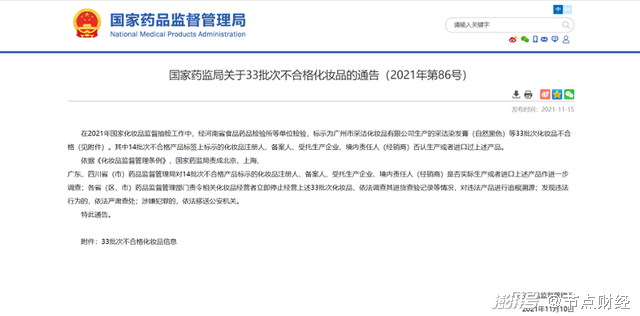
Image source: National Medical Products Administration
These negative events have obviously affected consumers’ minds to a certain extent. Baidu, Xiaohongshu, Zhihu and other platforms can show that many consumers continue to pay attention to these harmful substances, and it is common to ask whether the content of certain products exceeds the standard.
According to our statistics, the gross profit margin of L ‘Oré al (OR.PA) and Shiseido (SSDOY.OO) is stable at over 74% all the year round, with low cost, which is a profitable business.
Small workshops and brands may also use "poverty" to prevaricate. Although they have chosen a wrong path, they can still use "youth and ignorance" to gain understanding. However, such as L ‘Oré al and Shiseido, such high-margin businesses and wealthy enterprises, can still do things that are shameful to consumers with good reputation. It can only be said that they have not enough sense of social responsibility and have stayed in the comfort zone for a long time, trying to self-destruct their future.
/ 02 /
"The right to obtain correct information"
Wechat business’s exaggerated goods and false propaganda have been repeatedly banned.
With the intensive introduction of laws and regulations in China’s cosmetics industry, many problems have also been exposed in this industry, and false information has been repeatedly banned. From Taobao, some shocking propaganda will surface, and the data maps such as a white wash, a surge in hair volume in three days, and a three-day eye bag removal are ridiculous. I’m afraid similar products are not scientifically developed, but "one-click beauty".
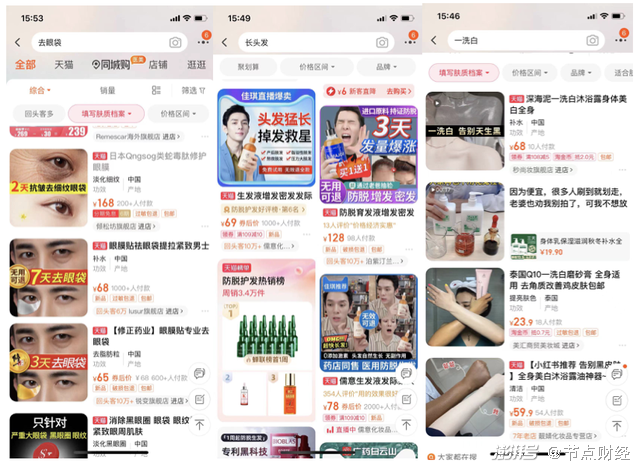
Image source: an e-commerce platform
With the development of mobile Internet and the continuous innovation of business model, there are more and more brands in Wechat business, and there are various illegal behaviors. For example, Zhang Ting, the "goddess of Wechat business", and the makeup brand "TST Court Secret" operated by Lin Ruiyang, with the popularity of the founder’s entertainment circle, Ming Dow, Tao Hong and other stars as their platforms, Wechat business represented over 10 million at its peak.
In addition to being suspected of pyramid selling, TST has also been caught in a storm for many times due to quality problems. In 2016, Weibo named "Happy Zhou Yaya" said that after three months of continuous use of TST products, the face skin was rough, peeling, blushing and yellow eyes could not be opened ",and TST evaded the past with" skin detoxification ". Zhang Ting also said that TST facial mask is in compliance with laws and regulations, and the three certificates are complete … However, in 2015-2016, dozens of products, such as TST anti-aging series and edelweiss series, were ordered to correct by the Food and Drug Administration.
Look at TST’s slogan "The Royal Brand of Zhang Ting, the Queen of Frozen Age". The "Queen of Frozen Age" may be true, but let’s just imagine that it is known that the 100-yuan mask, which costs only 4 yuan, will be used by female stars who cherish their faces like gold and spend money like dirt, and will be used for many years? Not to mention the 360-degree effect of "purifying skin surface, hydrating and moisturizing, firming and elastic, smoothing fine lines and brightening skin tone" is somewhat true.
Coincidentally, Zhang Ting is not the only one. Driven by money and new business models, more and more stars have embarked on this road, bringing some products that they can’t use, but boasting how easy it is to use; Or simply make a new brand yourself and go to PUA consumers with star aura and beauty influence. How much of the information involved is true?
Although many Wechat business brands are mostly made in China, it does not mean that foreign brands do not infringe on consumers’ right to obtain correct information. For example, in June 2019, an advertisement declared that a French cosmetics brand such as "8 days skin is like a new life", "the favorite choice of celebrities" and "skin problems are solved together" was punished for the effect of fictional use of goods.
Sephora, Estee Lauder, Chanel, Shiseido, L ‘Oré al and other big names have also been punished for false propaganda, mainly involving the efficacy and ingredients of products, and unclear expression of parameters such as the origin and use of goods.
False propaganda and providing false information may seem to have little damage to the brand; However, the safety problems caused by false propaganda and materials and the mutual exclusion of consumers’ skin will have a great negative impact on the brand and cannot be prevented.
/ 03 /
"the right to decide freely"
When will the small workshop stop bullying and luring?
It’s the 1920s. Is there still the problem of consumption freedom? Yes For example, the problem of buying and selling hard has been repeatedly banned. In August last year, some consumers complained about Shuixi International Health Center on the complaint of black cats. In the name of experience, they invited consumers into the store to continue to promote cosmetics and smeared things on their faces. Consumers wanted to leave, and the merchants said that they had to pay to leave, but the cosmetics that consumers had no choice but to buy had no logo.
What’s more, during the period of strong buying and selling, merchants also confiscated mobile phones, as shown below. It is not a case that the appearance of "coercion and inducement" appears in an irregular organization.
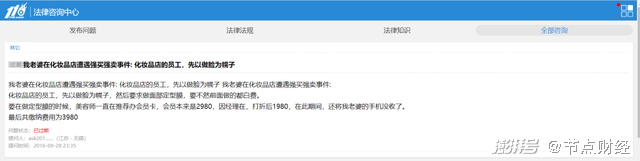
Image source: Legal Consultation Center
This kind of violation of consumers’ freedom often occurs in offline and informal small and micro beauty salons, and in the name of experience, the "three noes" cosmetics made by themselves or purchased at low prices are sold. For online, with the deepening of consumer rights protection, in the past two years, as long as it is purchased through formal channels, except for special goods, there are fewer and fewer goods that do not accept returns for seven days without reason.
/ 04 /
"Have the right to put forward consumer opinions"
Praise returns are endless, and false comments mislead consumers.
As consumers continue to be valued, the channels for consumers to speak are also rising, and everything is available online and offline. If you have any opinions on consumer goods, you can go to the Quality Supervision Bureau, the Food and Drug Administration, the Consumers Association and other regulatory authorities to complain; You can go to Taobao, JD.COM and other shopping platforms to comment; You can also make comments on social media such as Little Red Book, Weibo and WeChat. In this case, will it be infringed?
Yes Consumers who often spend money on shopping websites such as Taobao and Pinduoduo should be familiar with the red envelopes with favorable comments and cash back. This behavior seems to benefit consumers, but it is also misleading new consumers by inducing buyers to make false statements.
Although Taobao’s "Taobao Evaluation Standard" was changed last year, similar behaviors were prohibited, it is obvious that similar pictures are often wrapped in our express parcels. On other platforms, there are often brand public relations to brush comments or delete articles. This is why so many whimsical cosmetic efficacy brands have received rave reviews, which is simply "voting with their feet".
/ 05 /
coda
The road to rise is difficult, and it is done and cherished.
With the continuous development of new consumption, more and more business models emerge. Cosmetics are also marketed in various ways from offline to online, from Taobao to Tik Tok, from e-commerce to live broadcast. During this period, many new brands were born, which also provided a large-scale testing ground for the rise of domestic products.
At the same time, the violation of consumers’ rights is also "self-transcendence". For example, as mentioned above, stars may bring "goods" that even they dislike, blindly overdrawing consumers’ accumulated trust in the public, and finally they can only get back. For example, brand live broadcast engages in price discrimination, deceives consumers, and disintegrates consumers’ minds accumulated over the years. From quantitative change to qualitative change, it is hard to escape the consequences.
In the case of consumer infringement, there are no foreign monks who are better at chanting scriptures and have long been dishonest, and there are many international brands who rely on the international influence accumulated over the years to do many infringing things. For example, L ‘Oré al, in addition to several problems frequently mentioned in the above article, last year’s double eleventh ampoule mask incident caused various channels to fight with each other in preferential policies, and the eloquent "maximum strength for the whole year" and refusal to refund the price difference attracted tens of thousands of consumers to complain, and for this reason, it was "honored" by CCTV.
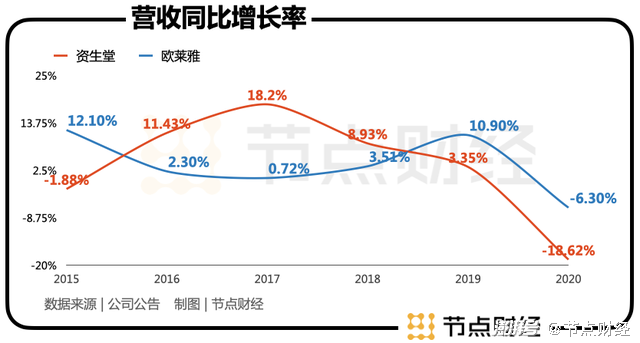
Although at present, international brands are still international brands, the degree of trust is not the same as that of that year, and the consumed consumers’ minds are as hard as ever. International is no longer quality assurance, luxury goods only have price. As shown in the figure, the revenue growth rates of L ‘Oré al and Shiseido both showed an obvious downward trend, and both were negative in 2020.
The China market is of unparalleled importance to many overseas manufacturers, and many manufacturers have benefited from the China market. China is currently the second largest market of L ‘Oré al Group in the world, and according to L ‘Oré al’s own estimation, it is only a matter of time before China grows into the first market.
For such an important China market, overseas manufacturers have not shown "exceptional treasure". With cultural self-confidence, the rising local cosmetics brands should not give overseas manufacturers more opportunities. In addition, domestic cosmetics have inherent advantages in controlling and responding to emerging consumption forms and adapting channels. It seems that overseas manufacturers are "returning" their rights to domestic products step by step.
After years of development, domestic cosmetics are indeed on the rise, and Polaiya and Hua Xizi have also gained a place. However, the rise of domestic products is not smooth. In the past, it was necessary to break down the moat of strong enemies with the poor trust of consumers who had experienced the era of "fake and shoddy" products in domestic products; Now, excellent domestic products have to bear the consequences of being destroyed by some unscrupulous merchants. Difficulties and obstacles, never absent.
When the tide of this country rises in the great era, there is already a cosmetics industry with high gross profit. It should assume more social responsibilities, pay attention to the protection of consumers’ rights and interests, and provide high-level products and services with a high-quality development posture. Only in this way, the company can obtain the rapid development of efficiency and market value.
Node Finance Statement: The content of this article is for reference only, and the information or opinions expressed in this article do not constitute any investment advice, and Node Finance is not responsible for any actions taken due to the use of this article.